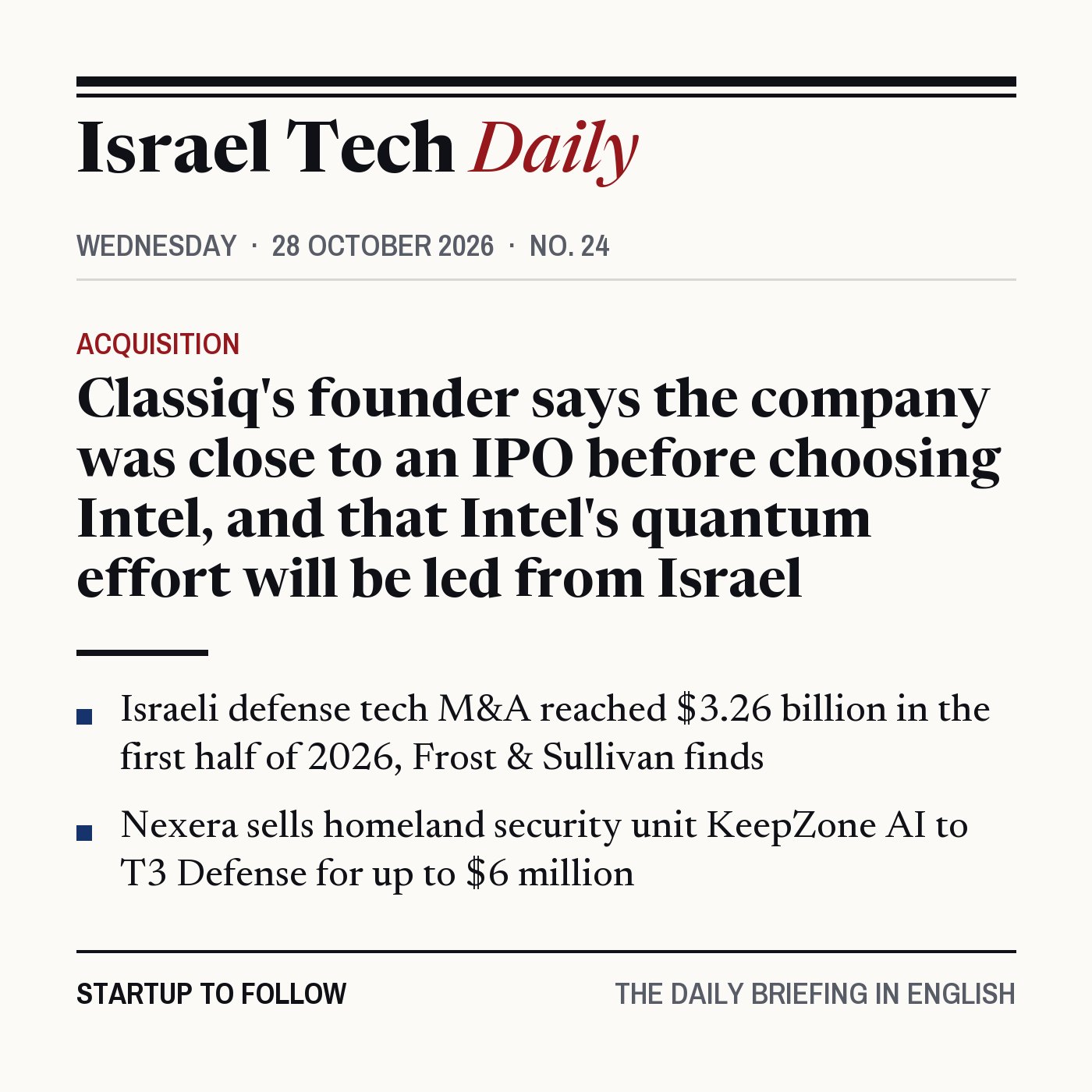
Classiq's founder on choosing Intel, Israeli defense tech M&A jumps to $3.26 billion, Nexera sells KeepZone
Classiq's chief executive tells Ynet the company came close to an IPO before Intel, and that Intel's quantum effort will be led from Israel. Plus a Frost & Sullivan report on defense tech deals, Nexera's KeepZone sale and Tel Aviv tech shares after the election.
In this episode
What to watch
Whether Tel Aviv's tech shares keep outperforming banks and builders as the final election count comes in.
This episode was brought to you by SkillSim. Interactive, timed AI hiring scenarios that test what candidates can really do, instead of take-home tasks they paste into ChatGPT. Try it free at skillsim.co.
Transcript
Noa Classiq's founder says the Israeli quantum company came close to going public before it agreed to sell to Intel, and that Intel's entire quantum effort will now be led from Israel.
Noa Good morning, it's Wednesday, the twenty-eighth of October. I'm Noa.
Eli And I'm Eli.
Noa Today, Classiq's founder on why he picked Intel, Israeli defense tech deals jump more than eightfold, and how tech shares held up in Tel Aviv the morning after the election.
Noa Yesterday we told you Intel is buying the Tel Aviv quantum software company Classiq for $2.3 billion. Today, co-founder and chief executive Nir Minerbi gave his own account to Ynet.
Eli He told Ynet that Classiq looked very seriously at going public, through either a SPAC or an IPO, and that it would be fair to say they were close. He would not discuss other suitors, beyond saying there was general strategic interest.
Noa The bigger news for Israel is where the work will sit. Minerbi says Intel sees Classiq as the strategic and business lead for all of its quantum computing, software, hardware, business and strategy, and that, in his words, it will happen from Israel.
Eli Classiq becomes a business unit reporting to Intel's chief technology officer. Minerbi says Intel has about 70 people in quantum today and Classiq has 140, so the deal roughly doubles that headcount. He expects the group to grow a lot, though not all of it in Israel.
Noa On revenue he was careful. He told Ynet that Classiq has bookings in the low tens of millions this year, and he was blunt about the market, saying quantum computing does not deliver commercial value to anyone today. Companies pay, he says, because they are preparing for it.
Eli Geektime spoke to Tami Shahar, head of Qubit IL, the umbrella group for Israeli quantum companies. She called it the largest deal yet in the global quantum industry, and said Intel is buying a software layer that serves the whole market, not just its own chips.
Eli A growing team means hiring, which brings us to our sponsor, SkillSim. Setting up an interactive AI interview scenario takes roughly a minute, and since replies run against a clock with pasting blocked, the answers you read are the candidate's own. Try it free at skillsim.co.
Noa Now, defense technology. The Jerusalem Post reports, from a Frost and Sullivan study it saw exclusively, that mergers and acquisitions in Israel's defense tech sector reached $3.26 billion in the first half of this year. That is about eight and a half times the $384 million the report gives for 2025.
Eli The study looked at 44 announced deals in Israel's aviation and defense sectors from 2023 to 2026, leaving out cyber. Values were disclosed for 22 of them, totaling about $4.1 billion, with a median deal of about $38 million. A few large deals drove much of this year's jump.
Noa Who is buying? American acquirers made up about 45 percent of the deals, Israeli buyers about 30 percent and European companies about 11 percent. More than half were in three areas, defense electronics and sensors, drones and autonomous systems, and ground robotics.
Eli Frost and Sullivan says defense companies increasingly prefer to buy technology rather than build it. Irit Nudelman, who heads its defense consulting for Israel and Europe, expects more big deals, mainly in anti-drone systems, robotics, underwater systems, space and autonomy.
Noa At the same event, retired Major General Amir Eshel, a former Air Force commander who is now a partner at the defense fund Aurelius, warned against weakening Israel's own defense innovation base by moving early-stage companies abroad.
Eli A small deal on the same theme. Nexera Technologies, an Israeli company listed on Nasdaq, has agreed to sell its homeland security unit, KeepZone AI, to T3 Defense, according to a market report from AllPennyStocks carried by The Globe and Mail. The total price is up to $6 million.
Noa Nexera gets $1 million in T3 Defense stock at closing, plus half of KeepZone's after-tax profit for two years, capped at $5 million. KeepZone sells screening, surveillance and counter-drone systems, including a voice-analysis platform. T3 Defense plans to make it its homeland security sales arm in Israel and abroad.
Eli Nexera shares jumped about 38 percent on Tuesday, to 62 cents. It keeps its Amazon Marketplace retail business, and the deal is expected to close within 60 days of signing.
Noa To the markets. Trading in Tel Aviv opened sharply lower this morning, the day after the Knesset election, which Globes says looked indecisive with about two thirds of the votes counted. There was no trading on election day itself.
Eli Globes reports the Tel Aviv 35 index was down about 1.4 percent and the Tel Aviv 125 down about 1.9 percent. Construction and real estate were hit hardest, with the construction index down almost 6 percent, along with the banks. The shekel weakened, to about 3.08 to the dollar.
Noa Technology held up better. The BlueTech Global index slipped only about 0.6 percent. Globes says Tower Semiconductor rose about 3 percent, Palo Alto Networks about 3.4 percent and Gilat Satellite about 2.4 percent.
Noa Now the quick round-up.
Eli Staying with Palo Alto Networks, CTech reports that chief executive Nikesh Arora's pay fell 19.5 percent to about $80 million for fiscal 2026, almost entirely because of lower stock awards. After shareholder feedback, the board also cut the cap on future performance shares to three times target, from four.
Noa Two Israeli researchers, Harel Rom and Gabriel Balko, say an open-source AI tool they built, called Open-Kritt, found a single software flaw that earned them a $500,000 bug bounty, Geektime reports. They say the flaw could have put about $100 million at risk. The software and the payer have not been named.
Eli And the Jerusalem Post profiles NanoCo, founded by brothers Lazar and Gavriel Cohen, which builds security and governance controls around AI agents. Its open-source platform, NanoClaw, runs agents in isolated sandboxes and sends sensitive actions to a human for approval. The company has about 20 employees, with research and development in Israel.
Noa One thing to watch. Globes' early market figures came with only about two thirds of the vote counted, so watch whether Tel Aviv's tech shares keep outperforming the banks and builders as the final count comes in.
Eli This episode was brought to you by SkillSim. If you're a team lead making your first hires and want to see how someone handles the real work before you commit, check them out at skillsim.co.
Eli Follow Israel Tech Daily in your podcast app, and read more at startuptofollow.com.
Noa See you tomorrow morning.
Questions from this episode
Did Classiq consider an IPO before agreeing to sell to Intel?
Yes. Classiq co-founder and chief executive Nir Minerbi told Ynet on 27 October 2026 that the Israeli quantum software company seriously examined going public through a SPAC or an IPO, and that it would be fair to say it was close to doing so. He said there was also general strategic interest from others, before Classiq agreed to be acquired by Intel for $2.3 billion.
Will Intel's quantum computing business be run from Israel after the Classiq deal?
According to Classiq chief executive Nir Minerbi, speaking to Ynet, Intel sees Classiq as the strategic and business lead for all of its quantum computing work, covering software, hardware, business and strategy, and that will happen from Israel. Classiq will become a business unit reporting to Intel's chief technology officer. Minerbi said Intel has about 70 quantum employees and Classiq about 140.
How much did Israeli defense tech M&A reach in 2026?
Mergers and acquisitions in Israel's defense technology sector reached $3.26 billion in the first half of 2026, up about 8.5 times from $384 million in 2025, according to a Frost & Sullivan report reported exclusively by The Jerusalem Post on 27 October 2026. US acquirers accounted for about 45% of the deals reviewed and Israeli buyers about 30%.
Who is buying Nexera's KeepZone AI and for how much?
Nexera Technologies, an Israeli company listed on Nasdaq, agreed to sell its homeland security subsidiary KeepZone AI to T3 Defense for up to $6 million, according to an AllPennyStocks report carried by The Globe and Mail on 27 October 2026. Nexera receives $1 million in T3 Defense stock at closing plus half of KeepZone's after-tax profit for 24 months, capped at $5 million.
Israel Tech Daily is written each morning from the day's reporting in English and Hebrew, and every story links to its sources above. The hosts, Noa and Eli, are AI voices. Spotted a mistake? Tell us and we will correct it on air.