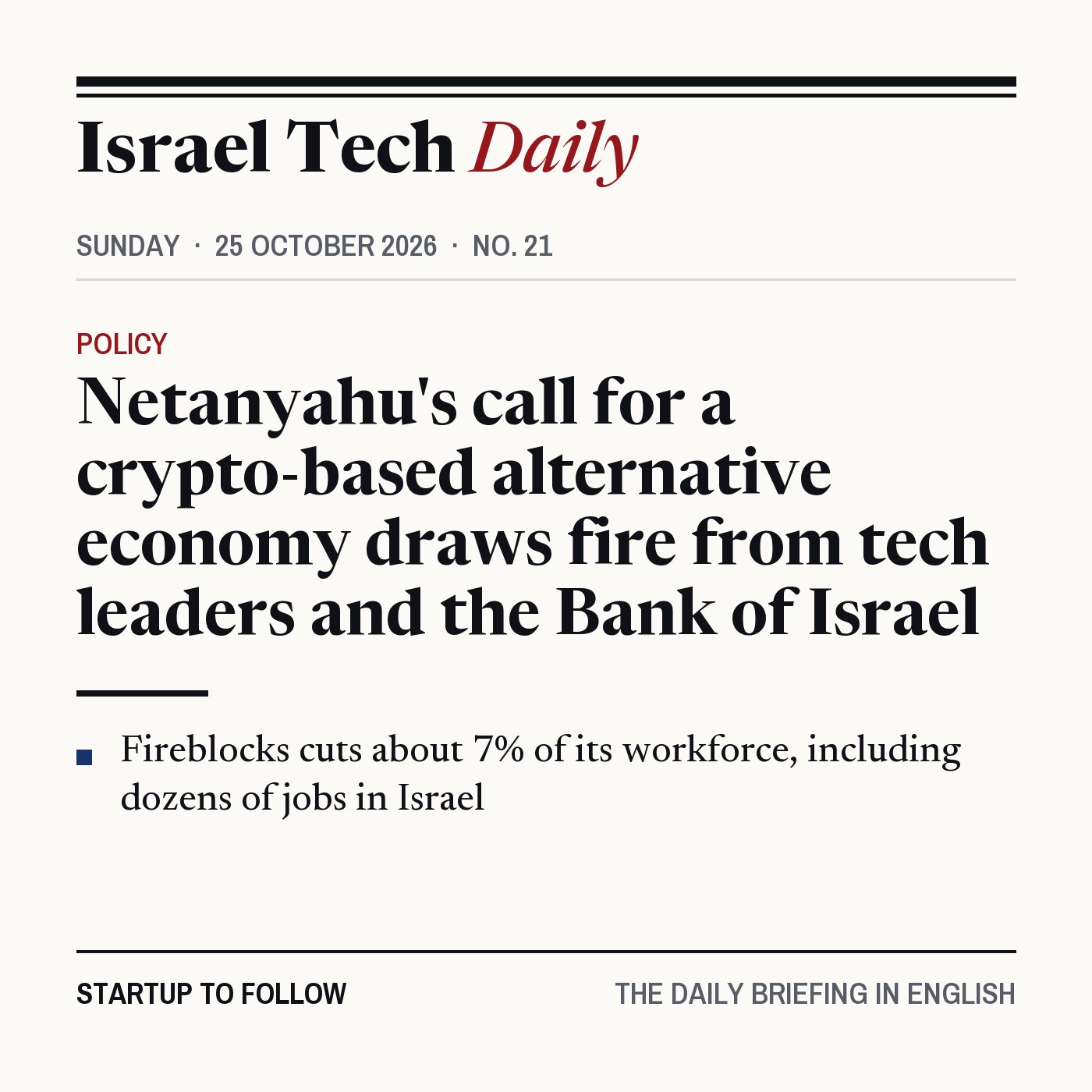
Tech backlash to Netanyahu's crypto plan, Fireblocks cuts 7% of staff, and FIMI's $65 million Maytronics bid
Israel's tech industry and the Bank of Israel push back on Netanyahu's call for a crypto-based alternative economy, Fireblocks cuts about 7% of its workforce, and FIMI offers $65 million for half of Maytronics.
In this episode
What to watch
Whether the alternative-economy plan Netanyahu says he has requested is ever published, and how tech companies and investors respond after the election.
This episode was brought to you by SkillSim. Interactive, timed AI hiring scenarios that test what candidates can really do, instead of take-home tasks they paste into ChatGPT. Try it free at skillsim.co.
Transcript
Noa Prime Minister Benjamin Netanyahu says Israel should prepare an alternative economy, using cryptocurrencies to get around possible sanctions. Israel's tech industry, and the Bank of Israel, are pushing back.
Noa Good morning, it's Sunday, the twenty-fifth of October. I'm Noa.
Eli And I'm Eli.
Noa This weekend, the backlash to Netanyahu's crypto plan, a new round of layoffs at Fireblocks, and a pool robot maker once worth billions, now selling half of itself for $65 million.
Noa We start with the story that dominated the weekend. In a television interview on Friday, Netanyahu said banking sanctions could be imposed on Israel, and that the country needs an alternative economic framework to get around them. Asked whether blockchain was that alternative, Globes reports he said, one of them, certainly. He said he had already asked for a plan.
Eli CTech says he also tied it to American defense aid, saying Israelis should not expect it to continue, because America has changed. And CTech notes the remarks came just days before the election.
Noa The reaction from tech was fast. The Israeli High-Tech Headquarters called the remarks highly dangerous for the Israeli economy, and for Israel in general. It said the idea of an isolated economy is absurd, and that the prime minister has forfeited the right to lead.
Eli Mellanox founder Eyal Waldman told Calcalist the idea was dangerous and absurd, and compared it to Iran and North Korea. Professor Itai Ater, head of economics at Tel Aviv University, warned that sanctions would send unemployment up immediately and make investment disappear.
Noa Then, on Saturday evening, the Bank of Israel issued a statement that Globes calls extraordinary. It said cryptocurrencies cannot serve as a means to get around sanctions. The right course, it said, is to keep economic ties with Israel's main trading partners and prevent sanctions, and that is the responsibility of the political leadership.
Eli Netanyahu's side is not backing down. Professor Avi Simhon, head of the National Economic Council, told Calcalist the prime minister is genuinely thinking about this. And in a Channel 14 interview on Saturday, Globes reports, Netanyahu said crypto is one of several tools, not the only one, and it is not certain it will be used. He thanked the Bank of Israel for its advice.
Noa Before we get to Fireblocks, a quick word from this episode's sponsor, SkillSim. If you're hiring, SkillSim swaps the take-home task for a short, timed AI scenario that candidates can't paste into ChatGPT, so you see what they can really do before the interview. Try it free at skillsim.co.
Eli Now, Fireblocks. On Friday we told you about a report, from Axios, that Visa is in advanced talks to buy the company for about $2.5 billion, which Fireblocks denied. Today, CTech reports Fireblocks is cutting about seven percent of its workforce.
Noa That's about sixty to seventy people, out of roughly nine hundred worldwide, with dozens of the jobs in Israel. The company says it's a difficult but necessary decision, and that affected employees will get an enhanced severance package and help with what comes next.
Eli CTech says it's the third round of cuts in recent years. About thirty people, or five percent, went in February 2023, and about twenty more, around three percent, a year later.
Noa On the Visa report, Fireblocks said on Thursday, this is news to us, and not true at present time.
Eli Fireblocks builds infrastructure for banks, exchanges and fintechs to store, move and manage digital assets, and has expanded into stablecoin payments. CTech says it has raised about $1.04 billion in total, including $550 million at an $8 billion valuation in January 2022.
Noa Next, a long fall. Maytronics, the pool cleaning robot maker based at Kibbutz Yizre'el, said on Friday that the FIMI fund, managed by Ishay Davidi, has offered to invest two hundred million shekels, about $65 million, for half of its shares.
Eli CTech says that implies a pre-money valuation of two hundred million shekels, below earlier estimates of three hundred million. FIMI would pay a seven percent discount to the share price, and the kibbutz would be left with twenty-eight percent.
Noa FIMI would also get options to invest up to a hundred and fifty million shekels more by the end of 2028, at higher valuations. Maytronics has given it sixty days of exclusivity, and any deal needs shareholder approval.
Eli The contrast is stark. At its peak in 2021, CTech says, Maytronics was worth 9.1 billion shekels, about $2.9 billion. Back then, each of the kibbutz's three hundred members had a stake worth about seventeen million shekels. Today, it's about three hundred thousand.
Noa Defense tech now. Denmark has chosen the Anthem cruise missile from Covenant, a US defense startup with research and manufacturing in northern Israel. CTech reports Denmark is buying it alongside Kongsberg's Joint Strike Missile, as its first long-range precision missiles.
Eli Denmark's defense minister, Jeppe Bruus, said the country is in a serious and deteriorating security situation, and the ministry says NATO requested the weapons. He would not say how many missiles Denmark will buy, or what it will pay.
Noa Covenant was founded in 2024 by Michael Kaufman and Ofir Dayan, and came out of stealth in September. CTech says it raised just over $250 million from investors including Andreessen Horowitz, Founders Fund and Israel's Aleph, at an estimated valuation above $1 billion.
Eli Citing Reuters, CTech says the Israeli site can make up to two thousand units a year. Covenant called Denmark's choice a major milestone for the company and for European defense.
Noa And a small, quick exit. The Jerusalem Post reports that Swap Commerce has bought Vizby, an Israeli AI startup, for an undisclosed sum that industry sources estimate in the millions of shekels.
Eli Vizby helps Shopify sellers get found and sell through AI platforms like ChatGPT and Gemini. Its four founders are all twenty-eight, and the Post says it had been operating for only a couple of months, with no substantial outside investment.
Noa Now the quick round-up.
Eli Bill Ackman, whose investment in 2Delta we covered on Friday, told Calcalist he has invested about $100 million in Israel, and expects an Israeli company worth a trillion dollars within five to ten years. He says he is working with two Israeli universities on a donation that could be announced toward the end of the year.
Eli Geektime reports that AI companies are paying for the Slack messages, emails and Jira tickets of startups that shut down, to train their models. Citing Forbes, it says Israeli startup SimpleClosure, which helps companies wind down, handled one such sale for the transcription company cielo24.
Noa And ice looks at Israeli celebrities investing in tech. Singer Omer Adam is a partner in the data center company Anan, whose estimated value passed $1 billion after a deal with US AI infrastructure company Crusoe, starting at forty megawatts at its site in Afula.
Eli One thing to watch. Netanyahu says he has asked for a plan for an alternative economy. Whether that plan is ever published, and how tech companies and investors respond once the election is over, will matter well beyond the campaign.
Noa This episode was brought to you by SkillSim. If you're a founder or hiring manager who wants to test real skills, not just a polished CV, before you hire, check them out at skillsim.co.
Noa Follow Israel Tech Daily wherever you get your podcasts, and read more at startuptofollow.com.
Noa See you tomorrow morning.
Questions from this episode
What did Netanyahu say about crypto and sanctions?
In a television interview on Friday 23 October 2026, Prime Minister Benjamin Netanyahu said banking sanctions could be imposed on Israel and that it needs an alternative economic framework to get around them. Asked whether blockchain was that alternative, he said "one of them, certainly" and that he had asked for a plan, Globes reports. On 24 October he said crypto is one tool among several and may not be used.
How did the Bank of Israel respond to Netanyahu's crypto plan?
On the evening of 24 October 2026 the Bank of Israel said cryptocurrencies cannot serve as a means to circumvent sanctions, and that the right course is to keep economic relations with Israel's main trading partners and prevent sanctions, which it called the responsibility of the political leadership. Globes described the statement as an extraordinary step.
How many employees is Fireblocks laying off?
Fireblocks is cutting about 7% of its global workforce of roughly 900, or about 60 to 70 people, including dozens in Israel, CTech reported on 23 October 2026. The company called it a difficult but necessary decision and said affected staff will get enhanced severance. It is Fireblocks' third round of cuts, after about 5% in February 2023 and about 3% a year later.
How much is FIMI offering for Maytronics?
The FIMI fund, managed by Ishay Davidi, has offered to invest NIS 200 million, about $65 million, in pool-cleaning robot maker Maytronics in exchange for 50% of its shares, the company announced on 23 October 2026, according to CTech. The offer implies a pre-money valuation of NIS 200 million. At its 2021 peak, Maytronics was worth NIS 9.1 billion, about $2.9 billion.
Which missile did Denmark choose from Covenant?
Denmark selected the Anthem ground-launched cruise missile from Covenant, a US defense startup with R&D and manufacturing in northern Israel, alongside Kongsberg's Joint Strike Missile, CTech reported on 23 October 2026. Denmark did not disclose the price or quantity. Covenant, founded in 2024 by Michael Kaufman and Ofir Dayan, has raised just over $250 million.
Israel Tech Daily is written each morning from the day's reporting in English and Hebrew, and every story links to its sources above. The hosts, Noa and Eli, are AI voices. Spotted a mistake? Tell us and we will correct it on air.