Using AI to Help Children With Dyslexia Learn in a Way That Works for Them
Pelebel is a DeepTech EdTech platform combining real-time AI, computer vision, neuroscience, behavioral science, SEL, accessibility, movement and play.
| Category | Education |
|---|---|
| Founder | Yuval Zohar Founder & CEO |
| Website | pelebel.com |
What does Pelebel do?
Pelebel is a DeepTech EdTech platform combining real-time AI, computer vision, neuroscience, behavioral science, SEL, accessibility, movement and play. Using only a standard webcam, it creates positive, immersive learning experiences that adapt to each child’s unique way of learning - across abilities, backgrounds and geographies.
The current landscape
AI is rapidly transforming education, but much of digital learning still follows a standardized model: children sit in front of a screen, complete predetermined activities, and are primarily measured by whether their answers are right or wrong.
At the same time, schools worldwide are facing increasing needs around personalization, learning differences, attention, inclusion, accessibility and social-emotional development.
Pelebel sits at the intersection of DeepTech, EdTech, AI, computer vision, embodied learning, neuroscience, behavioral science, accessibility and SEL.
Adjacent players include adaptive-learning platforms such as DreamBox, movement-focused platforms such as GoNoodle, physical-digital learning products such as Osmo, and emotional-regulation platforms such as Mightier.
Pelebel’s differentiation is the combination.
Rather than separating academic learning, movement, engagement and emotional development, Pelebel brings these dimensions together into one adaptive, movement-based learning environment.
The guiding idea is simple:
Children should not have to adapt themselves to technology. The learning experience should adapt to the child.
How Pelebel started
Pelebel started from a deeply personal experience.
Founder and CEO Yuval Zohar grew up with severe developmental dyslexia and was told as a child that she would never learn to read.
Her mother refused to accept that prediction.
Instead of assuming that Yuval could not learn, she began asking how Yuval learned differently. She studied learning disabilities, behavioral science and neuroscience and explored alternative ways to make learning more visual, experiential and accessible.
That approach changed Yuval’s trajectory.
She later studied visual communication, education, innovation and accessibility, became an educator herself, and developed a deep understanding of how the way information is presented can fundamentally change whether someone can access it.
The child who was once told she would never read eventually became a teacher helping children learn language and literacy.
Yuval founded and developed Pelebel together with an interdisciplinary team around a belief shaped by that experience:
A child’s difficulty does not define their potential. Sometimes the team needs to change the way learning reaches them.
Pelebel transforms that philosophy into technology.
The Pelebel solution
Pelebel is an adaptive DeepTech learning platform, currently focused primarily on children ages 3-10.
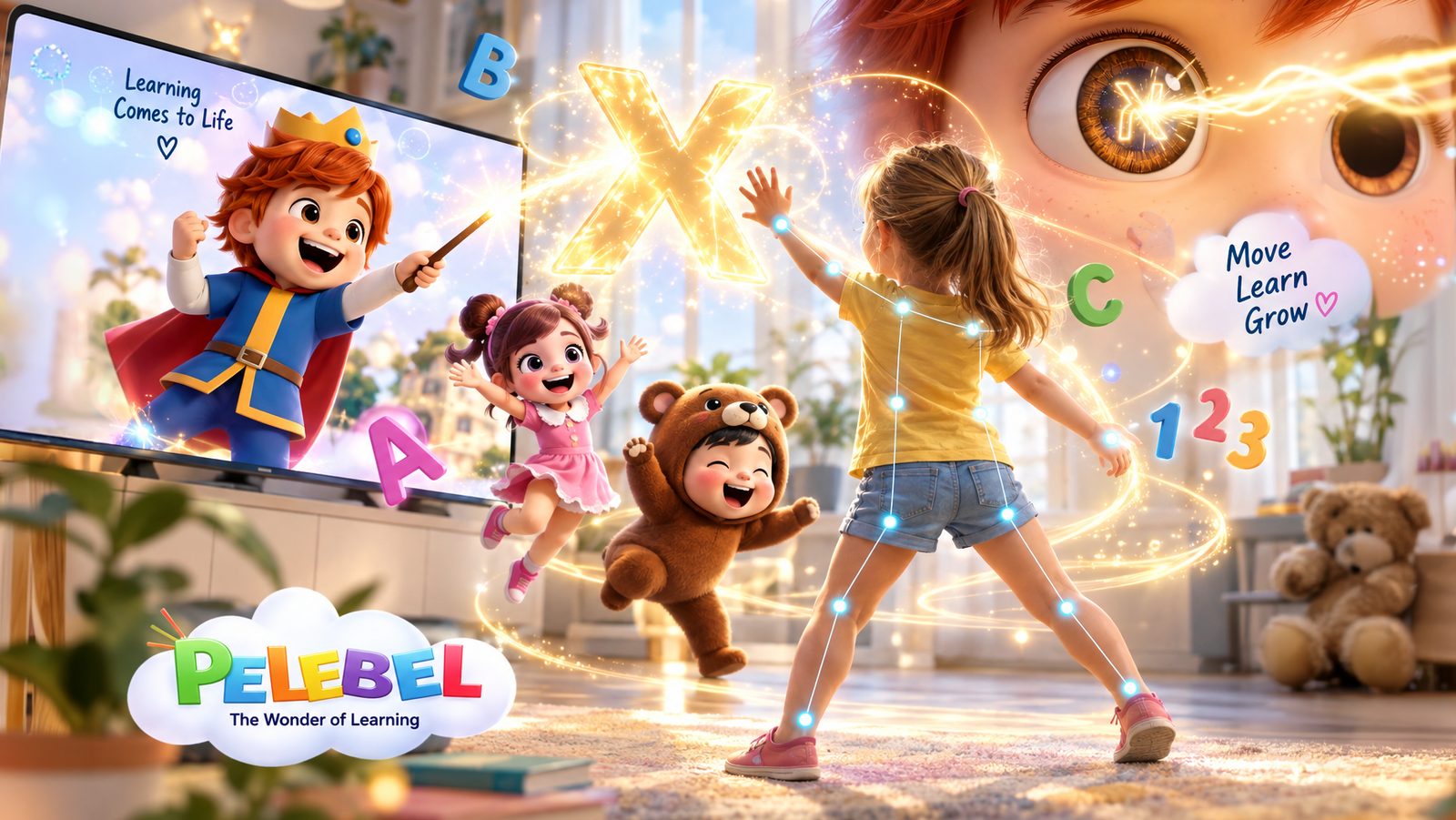
Using only a standard webcam, real-time AI and computer vision allow children to interact naturally with educational experiences through movement and play - without requiring wearables, controllers or specialized sensors.
The platform currently supports learning areas including literacy, language, mathematics, phonological skills, SEL, emotional understanding and real-world situation understanding.
But the experience is designed to be more than a collection of educational games.
Pelebel creates a positive, movement-based and immersive learning environment that adapts to the individual child.
No matter who that child is, whether they learn typically or differently, whether they have a disability or no diagnosis at all, Pelebel is designed to personalize the learning experience around them.
As children continue learning, the experience can evolve with them - supporting their strengths, challenges and individual learning journey without forcing them into one standardized pathway.
Pelebel also integrates social-emotional learning because the company believes learning cannot be separated from emotion. Confidence, curiosity, motivation and the willingness to try again are fundamental parts of how children learn.
For Pelebel, this is where emotion meets innovation.
Accessibility is equally central. Because the platform works with a standard webcam rather than expensive specialized equipment, Pelebel has the potential to reach children across very different schools, communities and socioeconomic environments.
The platform has already been used with more than 500 children across mainstream education, special education and early-childhood settings.
Pelebel has conducted paid pilots, is expanding implementation with schools and municipalities, and is an approved supplier through the Israeli Ministry of Education’s GEFEN framework.
The company is now expanding its technology, educational content, scientific collaborations, institutional partnerships and international activity.
The vision is global:
It should not matter where a child is born, what language they speak, what their socioeconomic background is, whether they have a disability, or how they learn. Every child, anywhere in the world, deserves the opportunity to learn in a way that works for them.
Ultimately, Pelebel is working toward one intelligent learning platform capable of adapting to many different children - so fewer children are left behind simply because the traditional way of teaching did not fit them.
As a child with developmental dyslexia, I was told that I would never learn to read. My mother refused to accept that as my future. Instead of asking why I could not learn like everyone else, she tried to understand how I learned and found another way to reach me. Today, that child is a teacher and a founder who, together with an incredible interdisciplinary team, has built technology to help other children learn. That is why Pelebel is personal to me. It should not matter who the child is, where they were born, what their socioeconomic background is, whether they have a disability, or how they learn. Our goal is not to make children adapt themselves to a system. Our goal is to create a learning experience that adapts to them - helping every child stay curious, build confidence, grow and discover what they are capable of, anywhere in the world.
>
— Yuval Zohar Founder & CEO
A Pelebel customer story
One of Pelebel’s most meaningful implementations has been in special education, including work with Tel Hai School in Haifa.
Children who can find conventional learning formats challenging were able to engage with academic content through movement, play and positive feedback.
What stood out was not only participation, but the children’s willingness to continue.
Instead of another experience focused on what they could not do, learning became something they could actively take part in.
That shift - from “I can’t” to “I want to try again” - captures what Pelebel is trying to create.
For the company, meaningful personalization is not only about delivering the correct level of content. It is about helping a child experience themselves as capable of learning.
The team culture at Pelebel
Pelebel was developed by Yuval together with a multidisciplinary team bringing expertise across AI, software and computer vision, education, neuroscience, behavioral science, pediatric neurology, accessibility, SEL, animation and child development.
That mix is intentional.
Children are multidimensional, so the company believes the technology designed for them must be multidisciplinary as well.
The team approaches product development by asking more than “Can we build this?”
They also ask:
Is it accessible?
Does it make sense to the child?
Does it create a positive experience?
And can it help that individual child learn and grow?
Pelebel is built around an AI for Good philosophy: technology should not replace educators, parents or professionals. It should give them better tools to understand and support each child.
The core cultural belief remains:
Do not ask the child to fit the system. Build the system to understand the child.