One Founder's Wager: That the Pop-Up Economy Is Bigger Than the Tools Built for It
Feels like there's a farmers market or pop-up on every block these days, right?
| Category | E-commerce |
|---|---|
| Founder | Tyler Rowland, Founder and CEO |
| Website | hivey.io |
What does Hivey do?
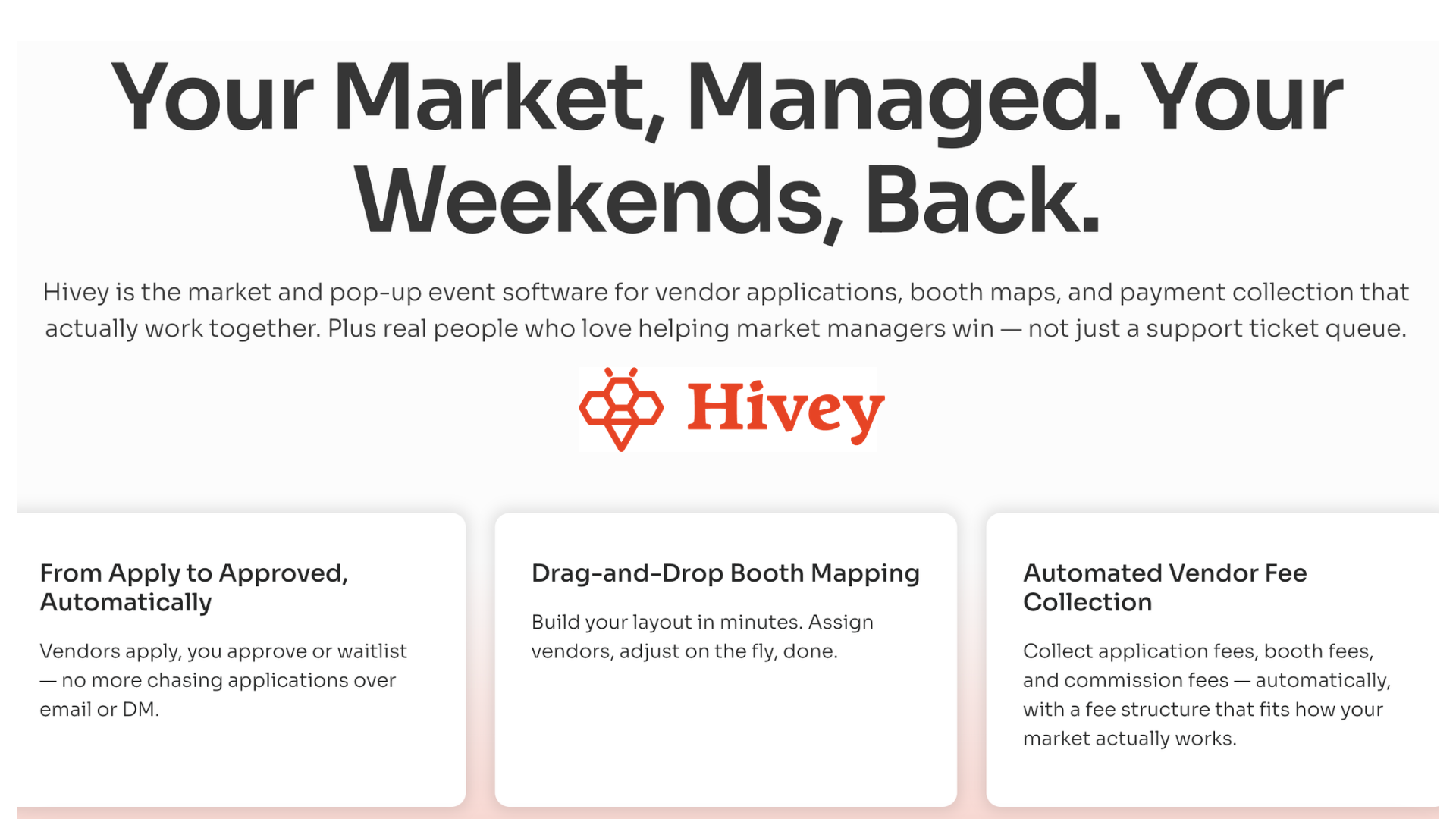
Feels like there's a farmers market or pop-up on every block these days, right? Turns out it's a billion-dollar industry running on spreadsheets and software that hasn't been updated since the early 2000s. Hivey is the modern fix: vendor applications, booth assignments, payments, and communications, all in one place.
The current landscape
Market and pop-up managers have basically had two options: duct-tape a system together out of spreadsheets, Google Forms, and a group text that never stops buzzing, or force-fit their operation into legacy software that might have made sense for someone's market once, but comes with pricing that doesn't fit, tech that hasn't been touched in a decade, and a team that stopped listening to feedback years ago. Worse, that pricing model punishes growth — the bigger and more successful a market gets, the more it costs to just keep running it.
Tyler saw an industry stuck with vendors nobody was building for anymore, and a new wave of market hosts nobody was building for at all. Enter Hivey: the modern fix that actually ships what managers ask for, like season pass billing and vendor waitlist functionality, and scales with markets instead of taxing them for growing.
How Hivey started
Hivey started three years ago as a simple booking platform for food trucks and breweries — nothing fancy, just a way to solve a headache Tyler knew firsthand. His team spent about a year building it and another six months selling it before an event company came knocking. The tools available weren't cutting it for what they needed, and they asked if Tyler's team would build something specifically for their industry.
So they re-built Hivey from scratch, with every workflow designed around the needs of a scaling event company. Farmers markets, festivals, vendor fairs, night markets — you name it, they ran it, and they needed one tool to manage and automate the work behind all of it.
That version launched in 2025. A year later, Hivey supports thousands of vendors and nearly 1,000 events across 15 states.
Hivey didn't start here. But that first idea put Tyler in exactly the right place to find a much bigger problem worth solving.
The Hivey solution
Generic event platforms can help you build a booth map, but only with the exact amount of booths that come with your subscription. They can't tell you which vendor bailed on you three weeks into a season, or automatically flag whose insurance is about to lapse. That's the gap Hivey was built to close — purpose-built for the recurring, vendor-heavy chaos that markets actually run on: season-long series and passes (not just one-off events), bulk vendor communication and approvals, drag-and-drop booth mapping, and automated insurance and compliance tracking. General event software skips all of this because it was never built around the vendor relationship.
Since launching in August 2025, Hivey has already become the backbone for market hosts managing 4,000+ vendors across multiple U.S. regions, processing almost $1 million in booth-fee payments. Traction has come from both ends of the spectrum: scrappy small teams running a single weekly market, and enterprise operators running sprawling event series — proof the model works whether you're running one Saturday market or a dozen.
The vision goes further than easing today's admin headaches: Hivey wants to be the operating system for the entire market and pop-up economy, building the data and infrastructure layer — reporting, vendor history, discovery — that helps managers, vendors, and shoppers grow together as markets keep popping up in new formats and places.
We don’t guess what to build. We build what our users tell us they need. That means we’re never sitting in a room trying to decide what the industry wants next—we’re building it alongside the people who use Hivey every day. It’s a platform for this community, built by this community.” -Tyler Rowland, Hivey CEO
>
— Tyler Rowland, Founder and CEO
The team culture at Hivey
At the core of Hivey's culture is fully immersing the team in what they're building. Tyler isn't just the CEO of Hivey — he's an active user of the platform every day, producing dozens of events and using the same tools Hivey's customers rely on to run theirs.
That mindset extends across the whole team. They believe the best way to build great software is to understand the work firsthand: stay close to the problems, use what you build, and experience the same workflows customers do.
It keeps the team grounded and gives everyone a simple goal: build the tool they'd want to use themselves.