Lux-backed Multiplier bets on "10xing" human stock-pickers
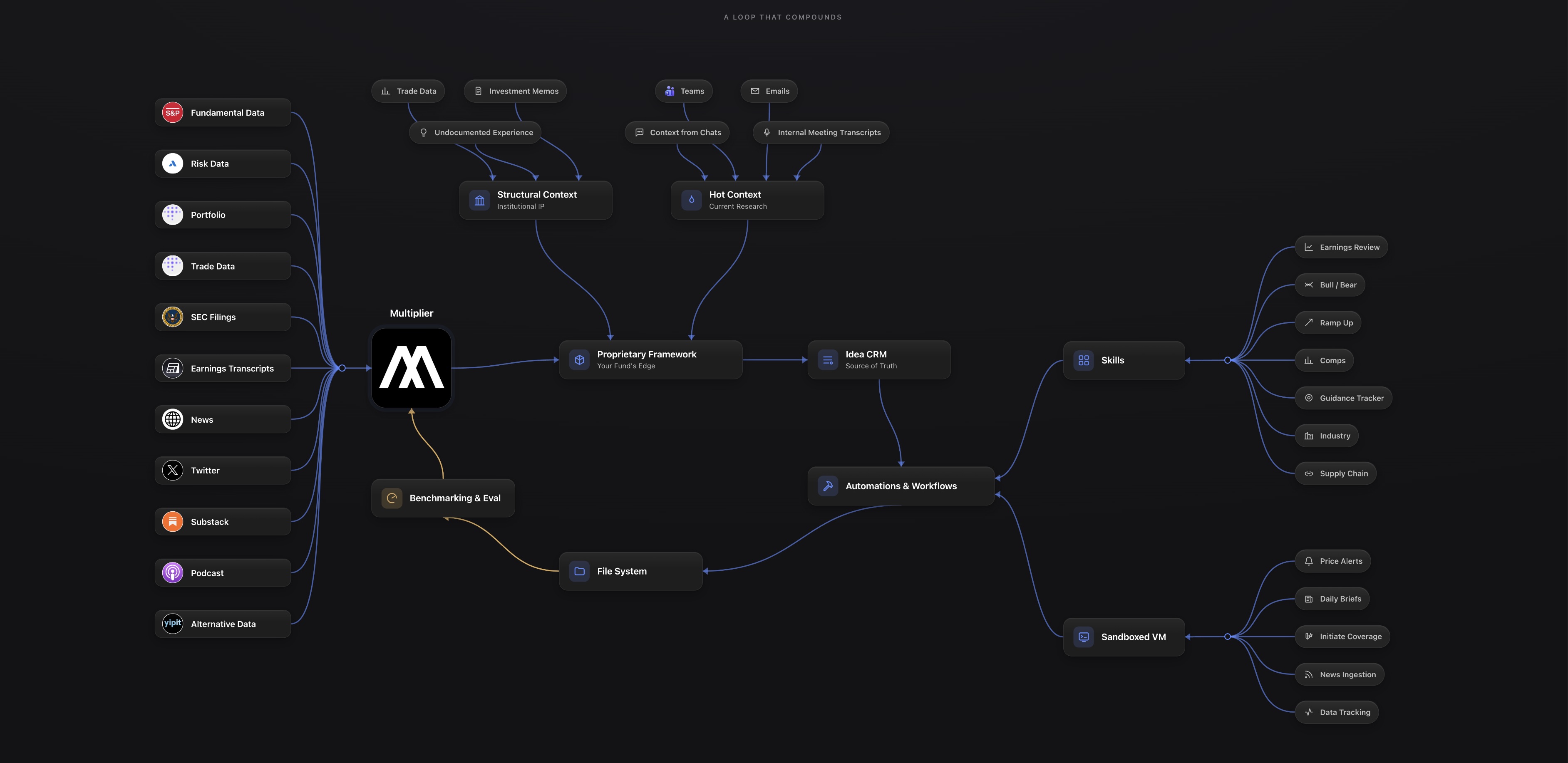
The Multiplier platform canonicalizes a hedge fund's data and investment frameworks, then uses that foundation to scale and refine the firm's work using AI agents.
The short answer
The Multiplier platform canonicalizes a hedge fund's data and investment frameworks, then uses that foundation to scale and refine the firm's work using AI agents.
| Category | Fintech |
|---|---|
| Founders | Ian McInnis, Benjamin Finch, Ryan Winkler |
| Founder | Ian McInnis (CEO), Benjamin Finch (CTO/President), Ryan Winkler (COO) |
| Named customers | Mercator Partners |
| Website | multiplier.ai |
What does Multiplier do?
The Multiplier platform canonicalizes a hedge fund's data and investment frameworks, then uses that foundation to scale and refine the firm's work using AI agents. The Multiplier team deploys and customizes that platform for each fund, serving as those investors' AI liaisons.
The current landscape
Multiplier positions itself as sitting between extant vertical tools like Rogo, AlphaSense, or Hebbia and duct-taped DIY AI efforts. Investment firms need both domain specialization and firm specialization: access to their research, tools, and context, with security that goes beyond compliance box-ticking.
How Multiplier started
Ben Finch, Ryan Winkler, and Ian McInnis became fast friends at Princeton, co-founding the Tiger Sustainable Investment Group. Ian went on to build LLM investment systems at Bridgewater Associates; Ben became the founding researcher at Sentient Labs; Ryan was an investor at StepStone. Ben and Ian had a call to catch up one night and were spooked by how they'd come to the same conclusions; they soon looped in Ryan, whom they consider "a stone-cold operator."
The Multiplier solution
Multiplier is a unified workspace where investors collaborate with AI on equity research, portfolio oversight, and everything else. It deploys the same infrastructure inside each customer's own systems, then builds firm-specific customizations on top: connecting agents to the real working environment, encoding the fund's workflows into reusable skills, and building bespoke evaluations with investor oversight.
The company is live with 8 funds and has raised $6 million in a seed round led by Lux Capital. Its ambition is to become the new operating system for investors.
We turn one analyst into three. We make good investors great. We make great investors superhuman.” — Ian McInnis, co-founder and CEO
A Multiplier customer story
Long/short energy-focused investment manager Mercator Partners helped incubate Multiplier, betting on the team before a product existed. Scott Hobart, Mercator's CIO, said: “We used to spend 80% of our time gathering information and 20% acting on it. Multiplier has flipped those percentages.”
The team culture at Multiplier
The team's long-term vision is “augmentation of all knowledge work for a rich, intelligent, human future.” They screen for "moral seriousness" in their recruitment, and several copies of Endurance lie around the office.
Frequently asked questions
What is Multiplier?
Multiplier is a unified workspace where investors collaborate with AI agents on equity research, portfolio oversight, and other fund operations.
Who founded Multiplier?
Multiplier was founded by Ian McInnis (CEO), Benjamin Finch (CTO/President), and Ryan Winkler (COO), who met at Princeton.
How does Multiplier work?
Multiplier deploys inside a customer's own systems to canonicalize the fund's data and investment frameworks. It then connects AI agents to the fund's environment, encodes workflows into reusable skills, and builds firm-specific customizations with investor oversight.
Who is Multiplier for?
Multiplier is built for hedge funds, investment firms, and stock-pickers looking to scale and augment their research and operations.
How does Multiplier differ from existing tools?
Multiplier positions itself between extant vertical tools and DIY AI efforts by providing both domain specialization and firm specialization, customized directly within each fund's systems and context.