Face2social Built a Face Search Engine That Refuses to Search the Whole Internet — On Purpose
Face2social is a US-only face recognition search engine.
| Category | Consumer |
|---|---|
| Founder | David Anderson, Founder |
| Website | face2social.com |
What does Face2social do?
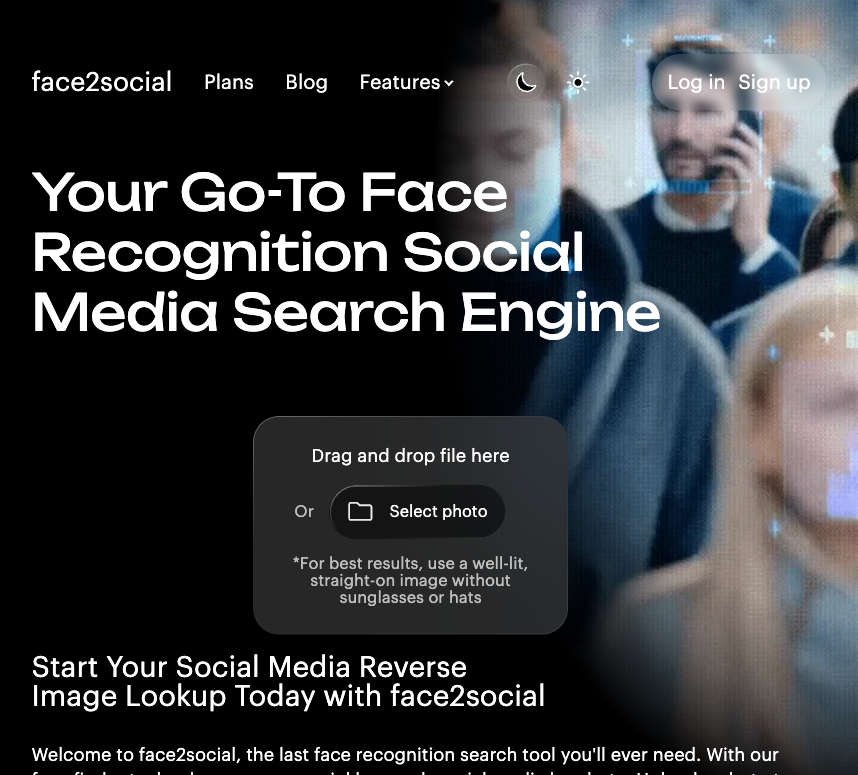
Face2social is a US-only face recognition search engine. Users upload a photo, and it matches facial features against public profile pictures on Instagram, Facebook, TikTok and X, returning candidate profiles in about 30 seconds. It is used to verify online dates and to find fake accounts reusing someone's photos.
The current landscape
Face search has consolidated around a small number of open-web engines. PimEyes and FaceCheck.ID crawl the public internet broadly and are, on raw coverage, the strongest tools in the category — a face that appears in a news photo, a conference gallery or a company team page will surface there and not on Face2social. Conventional reverse image search (Google Images, TinEye, Yandex) solves a different problem entirely: it matches image files rather than faces, so it fails the moment a photo has been cropped, filtered or re-saved, which is precisely what someone reusing stolen photos tends to do.
The category also operates under a regulatory shadow that shapes product decisions as much as engineering does. Clearview AI has been fined by data protection authorities across several European jurisdictions, and Illinois' Biometric Information Privacy Act has produced the largest settlements the sector has seen. Any company building here is making a jurisdictional bet, whether or not it says so out loud.
How Face2social started
Face2social started from an observation about how face search is actually used. The dominant real-world case is not investigative work but a defensive one: someone is talking to a stranger online and wants to know whether the person in the photographs is the person doing the typing. That user does not need the entire internet indexed. They need to know whether the face is attached to a social profile carrying a different name.
That framing produced the two decisions that shaped everything since. The first was to index public social media profile pictures only, and to accept the coverage loss that comes with the choice rather than paper over it. The second was to restrict the product to the United States and to keep people in the EU and other jurisdictions where this processing is prohibited out of the index entirely — a narrower launch, deliberately chosen over building broadly and negotiating with regulators afterwards.
The Face2social solution
Face2social converts an uploaded photo into a facial embedding and searches it against an index of public profile pictures from Instagram, Facebook, TikTok and X. Because the comparison is on facial geometry rather than pixels, matches survive cropping, filters, resolution loss and changes of angle — the exact failure modes that defeat conventional reverse image search. Queries return in roughly 30 seconds, run in the browser, and require no app install.
The differentiation is the narrow corpus, and the company presents it as a two-sided trade rather than a marketing claim. Profile pictures are an unusually consistent class of photograph — framed, front-facing, a single subject — so an index built exclusively from them tunes better than a general web crawl: higher recall and fewer false positives per query. The cost is complete blindness to anything outside social platforms. Face2social states this in its own marketing, including the fact that PimEyes and FaceCheck.ID beat it outright on open-web coverage.
Pricing is freemium, with a free preview of results shown before any payment, so a user who finds nothing pays nothing. The vision is not to grow into a broader search engine. It is to be the tool people reach for when the question is specifically whether a face is attached to a social account other than the one they are being shown — and to keep publishing the limitations of face matching as plainly as its capabilities.
Face matching gives you candidates, not verdicts. Any tool that presents a result as a confirmed identification is overselling what the technology does — including ours. The right way to use it is as one lead you then verify by other means.
>
— David Anderson, Founder